Wednesday, December 2, 2015

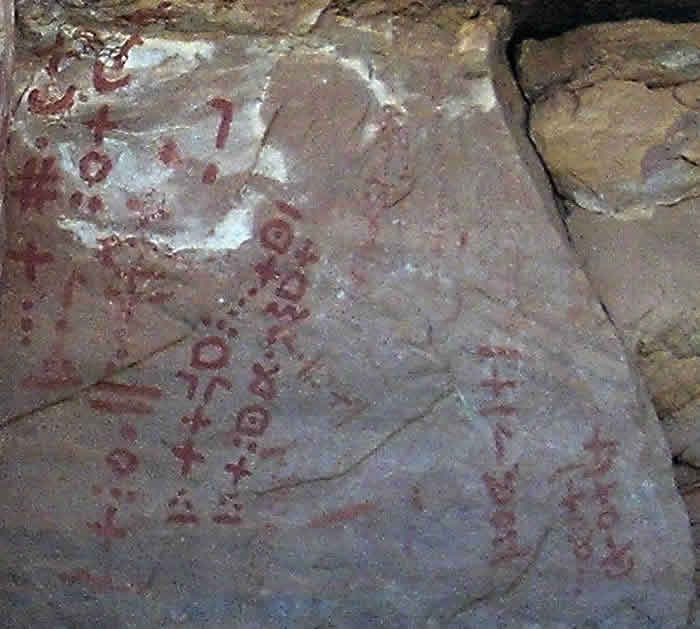
Tifinagh Alphabets scripts on Rocks

Tifinagh one ofThe Tifinagh alphabet ("Lybico-berber") has been used by Berber speaking people in North Africa and the Canary Islands at least from the third century B.C. up to the third century A.D. The only dated inscription is from 139 B.C. Its use disappeared, or had already disappeared, when the Arabs came. Of the two main variations, only the eastern one has been (partially) deciphered.
Among the Tuaregs, especially the Tuareg women, the use continued up to our time. There are many regional variations. The name Tifinagh of the alphabet is said to mean "Phoenician". A standardized version, sometimes called neo-tifinagh, is in use in primary schools in Morocco since Sept 2003.

Writing direction

Today, standard is left-to-right. But earlier also right-to-left was common. In ancient inscriptions one saw both bottom-to-top and top-to-bottom. For right-to-left writing, the glyphs are reflected in a vertical axis. For vertical writing, they are rotated. The following pictures are from Omniglot.
Vowels are not written. In order to avoid confusion with the l, the combination nn is written |/, and ln is written ||/.

Hanoteau

Tables of the tifinagh symbols as given by Hanoteau in Essai de grammaire Tamachek', 1896, including a table with combinations ("ligatures").

Motylinski

The section on the Tuareg alphabet in Grammaire, dialogues et dictionnaire touaregs by A. de Motylinski, 1908.

Thott-Hansen

The tables with the Tuareg alphabet in Afrikas sprog by P. Thott-Hansen, 1969.

Académie Berbère

In the late sixties, the Académie Berbère (Agraw Imazighen) came with proposals to standardise tifinagh writing. Here a comparison of the ancient alphabet, and various modern systems in regional use, and various proposals for standardisation, taken from Mondeberbere.

IRCAM

The Institut Royal de la Culture Amazighe IRCAM developed the 33-symbol alphabet given below, on the basis of the earlier proposals mentioned above.

yayabyagyagwyadyaḍ yeyyefyakyakwyahyaḥ yaε yaxyaqyi
a اb بg گgwd دḍ ض ef فk كkwh هḥ ح ε ع x خq قi ي
yajyalyamyanyuyaryaṛ yaγ yasyaṣ yacyatyaṭ yawyayyazyaẓ
j جl لm مn نu وr رṛ *) γ غ s سṣ ص c شt تṭ ط w وy يz زẓ ژ
*) The Arabic correspondence given is ر-with-three-dots-below , perhaps not in Unicode. This is the alphabet used by the publications of IRCAM. Texts written in it look rather unlike "classical" tifinagh texts because of the lack of those multi-dot symbols. Note the b glyph, different from everybody else's, while the latter has become the h. Here l and f have connected glyphs, and no special care is needed for the nn combination. Vowels are now written. See The IRCAM Tifinagh alphabet.

Unicode 4.1 values

In 2004 Tifinagh was added to Unicode. It covers the interval 2D30-2D7F (of which 55 positions are in use and 25 are reserved for future additions).
0123456789ABCDEF
2D30
2D40
2D50
2D60

Unicode names

The table below gives Unicode name, symbol, and font glyph. This allows you to test your Unicode Tifinagh font.
Unicode names are of the form TIFINAGH LETTER aa xx, where the aa part is empty or an origin indicator (here abbreviated: "A." is "AHAGGAR", "AY." is "AYER", "B." is "BERBER ACADEMY", "TA." is "TAWELLEMET", "T." is "TUAREG") and the xx part the Berber name of the letter.
The only exception is 2D6F, the TIFINAGH MODIFIER LETTER LABIALIZATION MARK.
YAYABYABHYAGYAGHHB. YAJYAJYADYADHYADDYADDH
ⴰⴱⴲⴳⴴⴵⴶⴷⴸⴹⴺ
YEYYAFYAKT. YAKYAKHHYAHB. YAHT. YAHYAHHYAAYAKH
ⴻⴼⴽⴾⴿⵀⵁⵂⵃⵄⵅ
T. YAKHYAQT. YAQYIYAZHA. YAZHT. YAZHYALYAMYANT. YAGN
ⵆⵇⵈⵉⵊⵋⵌⵍⵎⵏⵐ
T. YANGYAPYUYARYARRYAGHT. YAGHAY. YAGHYASYASSYASH
ⵑⵒⵓⵔⵕⵖⵗⵘⵙⵚⵛ
YATYATHYACHYATTYAVYAWYAYYAZTA. YAZYAZZ
ⵜⵝⵞⵟⵠⵡⵢⵣⵤⵥⵯ
Note that this Unicode repertoire is not an alphabet, but a random union of symbols that have been used recently. In some cases the meaning varies regionally. The YAH (2D40) is the Tuareg YAB. The YU (2D53) is the Tuareg YAW. The AYER YAGH (2D58) is the Adrar YAJ.

Links

Mondeberbere
Proel: tifinagh.
Proel: libico.
Lameens.
Ancientscripts.
Omniglot: tifinagh.
PetitPrince-Astronome-Tifinaghe.html. Tifinagh mise à l'épreuve.

The languages


Tamazight is used as a broad name (instead of Berber) and as a more narrow language name in the Middle Atlas. In Morocco: Tarifit (Riffi), Tachelhit (Tashelhiyt), and Tamazight. In Algeria: Kabyle, Tachawit. Tuareg: Tamasheq, Tahaggart Tamahaq, Tayart Tamajeq, and Tawallammat Tamajaq. These four Tuareg dialects are also collectively called Tamasheq.

 the oldest Alphabets in The world

Image result for rupestre rocks with tifinagh berber alphabets images

MOROCCAN BERBERS BATTLE TO KEEP FROM lOOSING THEIR CULTURE


Morocco's Berbers Battle to Keep From Losing Their Culture / Arab minority forces majority to abandon native language Peter Prengaman, Chronicle Foreign Service Published 4:00 am, Friday, March 16, 2001
001-03-16 04:00:0 PDT Rabat, Morocco -- A war of words over the Berber and Arabic anguages is heating up in Morocco, threatening to divide the kingdom in much the same way the battle between French and English speakers divides Canada.
Berbers were Morocco's first inhabitants, and today they are still the majority, accounting for about 60 percent of Morocco's 30 million citizens.
But when it comes to speaking their views, they are treated like a minority by the members of the dominant Arab culture.
"More than 40 years after independence (from France), the government still doesn't want to teach the Berber language and preserve or promote the culture, " says Ahmed Lachgar Agwilal, a Moroccan-born San Franciscan who is a representative of the Amazigh (Berber) Commission for Development and Human Rights in America.

"If you want to be Moroccan," he says, "you have to speak this language."
The government disagrees.
"Arabic is the official language of our identity, our Koran and our nation. The Moroccan citizen is duty-bound to speak his national language," says Khalid Shebal of the government's Institute for Arabization.
At the police registries where Moroccans go to officially designate their childrens' names, non-Arab names like Jurgurtha and Messina -- the names of ancient Berber kings -- are blacklisted. Only Arabic names like Hassan and Ahmed are allowed.
"To Berber militants, this is a case of trying to completely eradicate any Berber heritage," Jalali Saib, a leading activist who teaches at Rabat University, told the BBC earlier this year.
The first language of most Moroccans is some form of Berber, generally called Tamazight, though there are a number of variants. But the constitution recognizes only Arabic as the official language.
Arabic was imposed on the Berbers by the Muslims who conquered Morocco in waves of invasions beginning in the seventh century. Its influence waned a bit during the French colonial period, but after Morocco gained its
independence in 1956, it surged again. In the 1970s, the government launched a campaign to impose stricter standards for the use of Arabic in place of French in government and education.
Today, Berber activists say the "Arabization" of Morocco has led to discrimination and has marginalized their people. But the government has resisted calls for recognition of Tamazight as an official language of Morocco,
fearing that the crusade will spawn a separatist movement.
Morocco's Berbers are "people in their own country who don't exist," complains Mahjoubi Aherdan, the charismatic leader of the National Popular Movement, a political party that represents rural Moroccans, many of whom are Berber.
Even in schools in predominantly Berber areas, lessons are not taught in Tamazight but in Arabic. Government jobs are off-limits to those who speak only Berber, and Tamazight is prohibited in the courts; all legal documents must be translated into Arabic.
Television programming follows suit. One government-affiliated channel, 2M, broadcasts a mix of Arabic and French. The other, RTM, broadcasts predominantly in Arabic, with only 5 to 10 minutes a day of news in Berber.
Berber activists blame Arabization for the high illiteracy rate in Morocco - - 56 percent of its citizens cannot read -- because Berber children often drop out when confronted with teachers who speak only Arabic. They also blame it for the continued poverty of most Berbers. Fifty percent of Moroccans live on less than $50 a month, and most of the poor are Berbers.
Language is all-important to Moroccan Berbers because it is the main attribute that unites their pluralistic culture. Though most Berbers are Muslim, some are Jewish and others are Christian. They are ethnically mixed and spread over the country, from the Rif mountain range in the north to the Atlas Mountains and the desert in the south.
In Algeria, where Berbers make up 25 percent of the population, tensions have sometimes exploded into riots and bloody confrontations with police. The "Tamazight Spring" uprising of 1980 mobilized Berber anti-government sentiment,
and hundreds were killed in the "Black October" riots of 1988. More recently, thousands of Berbers rioted in 1998 over a government decree making Arabic the official language of Algeria and the subsequent assassination of Matoub Lounes,
a well-known musician and Berber activist, reputedly by the Armed Islamic Group, a fundamentalist insurgency.
Moroccan Berbers have been less violent in their resistance to Arabization. But the controls on political expression have loosened since Mohammed VI ascended to the throne in 1999 after the death of his father, Hassan II, and Berber activist organizations have become better financed. As a result, Berber calls to re-examine Moroccan society have grown louder.
Last March, Berber activists drafted and submitted to the government the "Berber Manifesto." It called on the state to recognize Tamazight as a national language, teach Tamazight in schools, license a Berber television station, allot government money to speed up development in historically neglected areas, and end restrictions on registering Berber names for their children.
Soon afterward, a government commission issued a much-publicized education charter calling for sweeping reforms of the Moroccan education system. The charter was commissioned by the late King Hassan II, who raised Berbers' hopes in 1994 when he said in a televised speech that Tamazight should be taught in schools, a pledge that was never fulfilled.
Berber organizations denounced the education charter. They pointed out that only two of its 100 articles deal with the question of Tamazight in school. The first said Tamazight could be used in primary school only to "facilitate the learning of the official language" -- Arabic. The second said that beginning this year, certain universities would have the means to study Tamazight and Berber culture.
The charter's provisions are "insufficient," says Lachgar. "The government has to provide money for teaching Tamazight because it's our language, it's our culture."
Not all Berbers agree. While the majority are poor, there is an entire class of super-rich Berbers. Discriminated against in areas like education and government, they have flourished as businessmen and have bought up entire neighborhoods of Casablanca, such as the enclave known as California, where mansions resemble those in Beverly Hills.
Some ardently support the Berber cause by funding activist groups, but others resist it. Says Ahmed Lousoure, a 34-year-old factory manager in Casablanca: "What good is Tamazight outside of Morocco? Our king is trying to modernize the country, not take a step back."
And there are divisions even among Berber activists.
Some militants are pushing for a political party exclusively for Berbers, while moderates worry that it would be interpreted as separatist, allowing the Berber movement to be written off.
Lachgar, who will travel in August to a U.N. conference on racism and indigenous peoples' rights in Durban, South Africa, to make the case for official recognition of the Berber language, shrugs off the government's suggestion that official recognition of Tamazight could lead to a separatist movement.
"They just want to confuse people," he says. "Nobody wants to separate because they consider all this land their land."

Tiny Ancient Shells -- 80,000 Years Old -- Point To Earliest Fashion Trend in Morocco

Tiny Ancient Shells -- 80,000 Years Old -- Point To Earliest Fashion Trend

Date:
August 27, 2009
Source:
European Science Foundation
Summary:
Shell beads unearthed from four sites in Morocco confirm early humans were consistently wearing and even trading symbolic jewelery as early as 80,000 years ago. These beads add to similar finds dating back as far as 110,000 in Algeria, Morocco, Israel and South Africa, confirming these as the oldest form of personal ornaments. Together these shells -- all from the Nassarius genus -- indicate a shared tradition passed along through cultures over thousands of years.      
FULL STORY

Perforated Nassarius gibbosulus from archaeological layers dated to between 73,400 and 91,500 years ago at Taforalt.
Credit: Image courtesy of d'Errico/Vanhaeren
Shell beads newly unearthed from four sites in Morocco confirm early humans were consistently wearing and potentially trading symbolic jewelry as early as 80,000 years ago. These beads add significantly to similar finds dating back as far as 110,000 in Algeria, Morocco, Israel and South Africa, confirming these as the oldest form of personal ornaments. This crucial step towards modern culture is reported this week in the Proceedings of the National Academy of Sciences (PNAS).
A team of researchers recovered 25 marine shell beads dating back to around 70,000 to 85,000 years ago from sites in Morocco, as part of the European Science Foundation EUROCORES programme 'Origin of Man, Language and Languages'. The shells have man-made holes through the centre and some show signs of pigment and prolonged wear, suggesting they were worn as jewelry.
Across all the locations shells were found from a similar time period from the Nassarius genus. That these shells were used similarly across so many sites suggests this was a cultural phenomenon, a shared tradition passed along through cultures over thousands of years. Several of the locations where shells have been found are so far inland that the shells must have been intentionally brought there.
"Either people went to sea and collected them, or more likely marine shell beads helped create and maintain exchange networks between coastal and inland peoples. This shows well-structured human culture that attributed meaning to these things," said Francesco d'Errico, lead author and director of research at the French National Centre for Scientific Research (CNRS). "Organised networks would also assist trading of other items, as well as genetic and cultural exchange – so these shells help reveal the connections between cognition and culture."
For scientists, beadworks are not simply decoration, they also represents a specific technology that conveys information through a shared coded language. It indicates more advanced thinking and the development of modern cultural traits, giving clues to how such innovative behaviours might link to the spread of humans out of Africa.
"The early invention of the personal ornament is one of the most fascinating cultural experiments in human history," d'Errico continued. "The common element among such ornaments is that they transmit meaning to others. They convey an image of you that is not just your biological self."
Until recently the invention of personal ornaments was thought to coincide with the colonisation of Europe some 40,000 years ago, linking advanced cognitive capacity to early human dispersal. Yet this changed with the 2006 discovery of shell beads in Africa and the Near East dating back 35,000 years earlier, showing that symbolic thinking emerged more gradually through human evolution.
Curiously, shell beads disappear from the archaeological record in Africa and the Near East 70,000 years ago, along with other cultural innovations such as engravings on ochre slabs, and refined bone tools and projectile points. They reappear in different forms up to 30,000 years later, with personal ornaments simultaneously re-emerging in Africa and the Near East, and for the first time in Europe and Asia. This may reflect an entirely new and independent phase of population growth with previously unseen innovations allowing a more efficient exploitation of a wider variety of environments.
The temporary disappearance of cultural innovations could well be linked to population decreases during a long period of harsher climate conditions 60,000 to 73,000 years ago. This would have isolated populations, disrupting social and exchange networks.
This study was part of a broad network of 21 research projects and 44 individual research teams from 12 European countries forming the European Science Foundation EUROCORES programme 'Origin of Man, Language and Languages' (OMLL). This highly interdisciplinary collaborative action brought together scientists from a wide range of disciplines including genetics, linguistics, anthropology, archaeology, neurophysiology or cognitive sciences.
Dr Eva Hoogland, EUROCORES coordinator for the cognitive sciences at the European Science Foundation said: "This study presents a very good example of the groundbreaking results that can be gained from an interdisciplinary environment. Some questions, such as those concerning the interconnections between human cognition and culture, can only be addressed if scientists of varying backgrounds join forces. As witnessed by this study, this opens up new avenues for research when it happens on a structural basis, by leading scientists from across Europe."
This research was also supported with funding from the Natural Environment Research Council, the British Academy and Oxford University in the UK and the Max Planck Society in Germany.

Story Source:
The above post is reprinted from materials provided by European Science Foundation. Note: Materials may be edited for content and length